
Why smart investors don’t follow the herd (and what you should do instead)
The Australian property market doesn’t move in a straight line—it moves in cycles.
But here’s where most people go wrong:
They buy in booming locations just because “everyone else is doing it,” only to get stuck when the market cools down.
The truth is, every state, city, and even suburb in Australia can be in a different phase of the property cycle—even at the same time.
What is the Property Market Cycle?
The property market cycle refers to the natural rise and fall of property prices over time. It repeats over and over—but the trick is knowing what stage a market is in and buying at the right time.
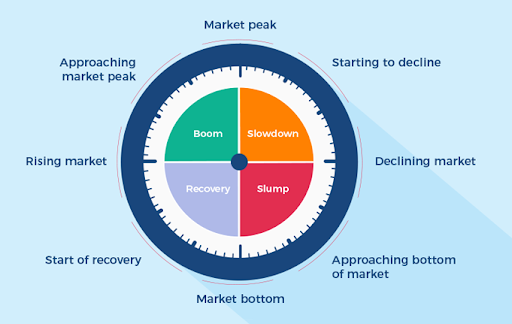
Each cycle has 4 key phases:
1. Boom Phase (Market Peak)
This is when the media is hyping real estate, everyone’s talking about property, and FOMO is everywhere.
- Prices rise rapidly
- Buyer demand is at its peak
- Properties are selling above asking
- Investors and first home buyers flood the market
📍 Examples:
Think of markets like Adelaide, Brisbane, Perth, and Townsville in recent years.
💡 Sounds great, right? But here’s the risk:
Some Buyers who jump in at the peak risk overpaying and get caught when the market slows.
2. Slowdown Phase (Transition Phase)
After a boom, markets often cool down. Why?
- Properties become unaffordable for locals
- Rents don’t keep up with purchase prices
- Investor activity slows
- Demand drops as people wait for prices to correct
The market begins transitioning from a seller’s market to a buyer’s market.
It doesn’t crash overnight—but the momentum fades, and growth plateaus (or dips slightly).
3. Slump Phase (Market Bottom)
This is the phase most people fear—but it’s actually where smart buyers strike gold.
- Prices hit rock bottom
- Market sentiment is negative
- Properties sit on the market for months
- Buyer activity is extremely low
- High supply, low demand
💡 But here’s the secret:
This phase presents the best buying opportunities. With little competition, flexible vendors, and negotiable pricing—you can often snag deals 10–20% below peak prices.
The downside?
You may need to hold for 18–24 months or more before seeing growth. But the upside?
You got in at the bottom of the market.
4. Recovery Phase (Rising Market)
After the slump, things start turning around.
- Rents rise, improving cash flow
- Affordability returns for local buyers
- Supply tightens
- Confidence slowly rebuilds
- Owner-occupiers and investors start coming back
Prices begin to grow steadily, and smart money moves in—before the headlines catch on.
Every Market Moves Differently
Here’s what most people forget:
Each state, region, suburb, and even property type moves through the cycle independently.
🔍 Example:
Just because houses in Bendigo are growing at 10% p.a. doesn’t mean units in Geelong are doing the same.
- Bendigo houses might be in the boom phase
- Geelong units might still be in the slump phase
That’s why you must research specific markets – Don’t generalise.
Why Understanding the Property Cycle Matters
Knowing where a market sits in its cycle helps you:
- Buy at the right time (not at the emotional peak)
- Target areas with short to medium-term capital growth
- Maximise ROI while minimising risk
- Stay calm when others panic (slump)
- Capitalise before the crowd (recovery)
The Key to Smart Property Investing?
Buy in locations that are in the Recovery Phase or entering the Boom Phase.
Avoid following the herd and buying in areas that have already peaked. That’s where most buyers make emotional, fear-driven decisions—and overpay.